Mimir answers project questions in Slack
Mimir searches the GitHub repositories and pages you connect and links to the sources it used. Each Slack thread keeps its history when the worker restarts.
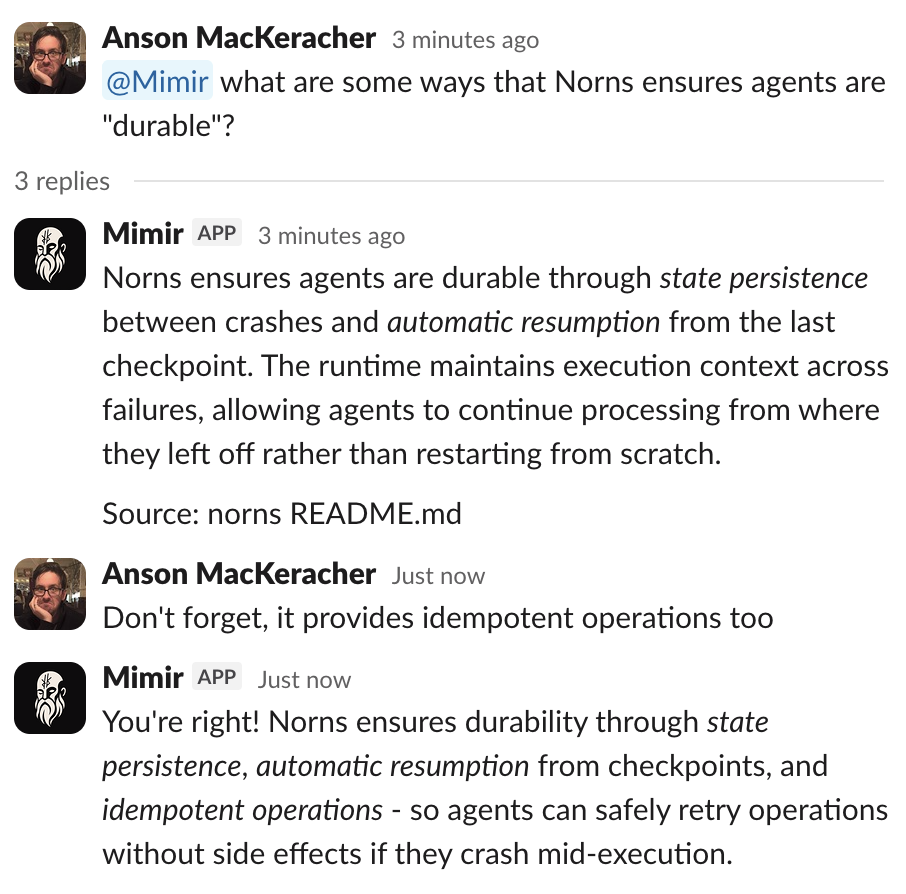
How a Slack thread survives a restart
A Python worker receives Slack messages and sends them to Norns. Norns saves the conversation using the Slack channel and thread IDs. A new worker can pick up that conversation and answer the next message.
Mimir searches sources when someone asks a question. It also stores facts explicitly shared with “remember this” in Postgres and can look them up in later conversations.
The same worker runs a scheduled agent that proposes work in Slack. Norns saves the pending question, so you can reply the next day even if the worker has been redeployed.
Mimir’s hosted run record
April 15 to October 4, 2026. 130 runs across 62 Slack threads.
| Runs that failed on a provider or request error | 11 |
|---|---|
| Runs that timed out waiting for a worker | 0 |
| Runs lost to an orchestrator restart | 0 |
| Norns redeploys | 104 |
| Mimir redeploys | 44 |
Run Mimir locally
You’ll need Norns, Docker Compose, an Anthropic API key, and a Slack app created from the README’s manifest. Compose starts Postgres and the worker.
nornsctl dev
nornsctl dev status
git clone https://github.com/nornscode/norns-mimir-agent.git
cd norns-mimir-agent
cp .env.example .env
Fill in .env with the Norns URL and API key from
nornsctl dev status, your Anthropic API key, and your Slack
bot and app tokens. Add GITHUB_TOKEN to read private
repositories. Then start the worker.
docker compose up